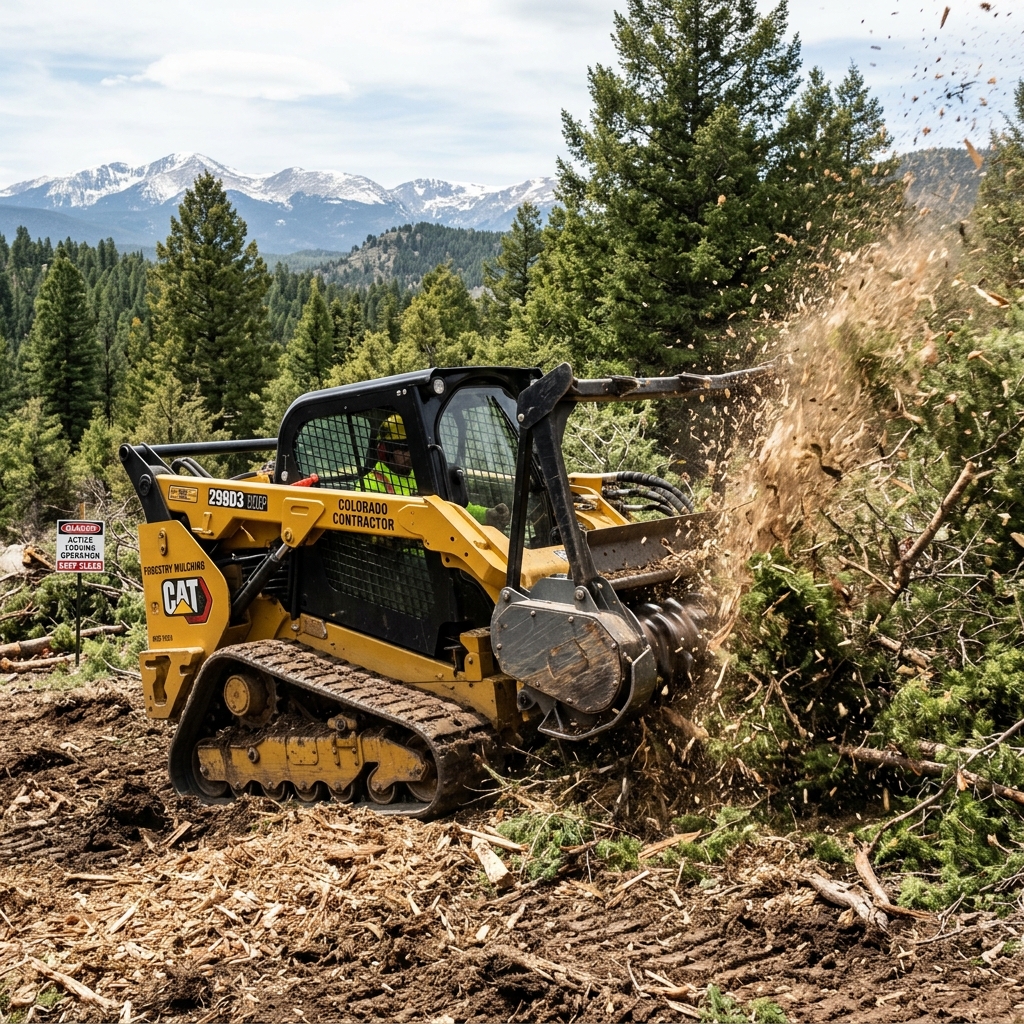
Redefining Land Development and Site Prep
Whether you are preparing a site for a new custom home in Loveland, clearing agricultural pastures in Greeley, or establishing a wildfire firebreak in the foothills of Fort Collins, land clearing is the necessary first step. Traditionally, this process involved heavy bulldozers pushing down trees, dragging out roots, creating massive slash piles, and hauling away organic debris. Today, **forestry mulching** offers a single-machine alternative that is faster, more environmentally friendly, and highly cost-effective.
What is Forestry Mulching?
Forestry mulching utilizes a specialized track loader equipped with a front-mounted masticating drum. This drum contains rows of rotating steel teeth that grind brush, saplings, stumps, and standing trees directly into mulch. Instead of uprooting vegetation, the machine processes it on the spot, leaving a clean, carpet-like layer of organic mulch behind.
Comparing the Methods
1. Environmental and Soil Impact
Traditional Clearing: Bulldozers scrape the topsoil, disrupting natural microbial structures and leaving the ground bare and highly vulnerable to severe wind and rain erosion. Heavy machinery causes significant soil compaction, making future plant growth difficult.
Forestry Mulching: Leaves the underground root systems of chopped brush intact, preserving the soil's natural structure and preventing erosion. The layer of wood mulch acts as a natural erosion-control blanket, protecting the topsoil, retaining moisture, and suppressing weeds.
2. Debris Disposal
Traditional Clearing: Generates massive piles of tree trunks, branches, and root balls. These must either be hauled away at high cost or burned on-site in large slash burn piles, which requires permits and carries fire risks in dry Colorado months.
Forestry Mulching: Eliminates hauling and burning completely. The vegetation is processed directly into mulch that remains on the property, returning nutrients back to the soil as it decays.
3. Cost and Labor Efficiency
Bulldozing requires multiple steps and machines: a dozer to push, a loader to pile, a wood chipper or haul trucks to clear, and a grader to smooth the soil. Forestry mulching is a **single-step process** executed by one machine and one operator, reducing labor hours and equipment transport fees.
Key Applications for Colorado Acreage
- Wildfire Firebreaks: Creating defensive space around residential structures by masticating dense oak brush, juniper, and low-hanging branches to eliminate fuel ladders.
- Utility Easement Clearing: Clearing paths for power lines, fences, and access roads through dense foothills brush without causing large-scale erosion.
- Ranch Restoration: Clearing invasive noxious weeds and brush thickets to restore grazing pasture land.
Selecting the Right Method
Forestry mulching is the ideal solution for brush clearing, underbrush mastication, firebreaks, and selective tree removal. However, if your project requires building foundations, utility trenches, or basements, traditional excavation to extract roots and root balls will still be necessary for those specific structural footprints.
Soil Health, Erosion Control, and Long-Term Site Ecology
One of the most overlooked benefits of forestry mulching is its positive impact on the local ecosystem. In the semi-arid climate of Northern Colorado, soil moisture is a precious commodity. Traditional scraper clearing exposes raw dirt to intense solar radiation, drying out the soil profile and destroying beneficial mycorrhizal fungi networks. By contrast, a 2-to-3-inch layer of masticated mulch acts as a protective blanket. This organic layer regulates soil temperature, dramatically reduces water evaporation, and slows storm runoff. Over several seasons, as the wood fibers slowly decompose, they return carbon and vital nutrients back into the soil, creating a rich humus layer that promotes healthy, native regeneration. Furthermore, this mulch barrier is highly effective at suppressing noxious weeds like cheatgrass, leafy spurge, and diffuse knapweed, which aggressively colonize bare soils after traditional bulldozing disturbances.
Navigating Larimer & Weld County Land Use Codes
Before initiating any large-scale lot clearing in Northern Colorado, it is essential to understand municipal codes and environmental guidelines. Larimer County's Land Use Code enforces strict storm-water management and erosion control regulations (frequently requiring stormwater permits for disturbances over an acre). Because forestry mulching does not disrupt the root systems or scrape the topsoil, it is often classified as a low-impact land management activity. This classification can simplify or completely bypass the costly stormwater permitting processes required for grading. In Weld County, agricultural properties benefit from clearing thickets and fence lines to maximize pasture space. However, property owners must still respect wetlands setbacks along the Cache la Poudre River and Big Thompson corridors, where clear-cutting and mastication are subject to riparian preservation codes. NoCo Services works closely with local county arborists and planners to ensure all projects are fully compliant with local environmental statutes.