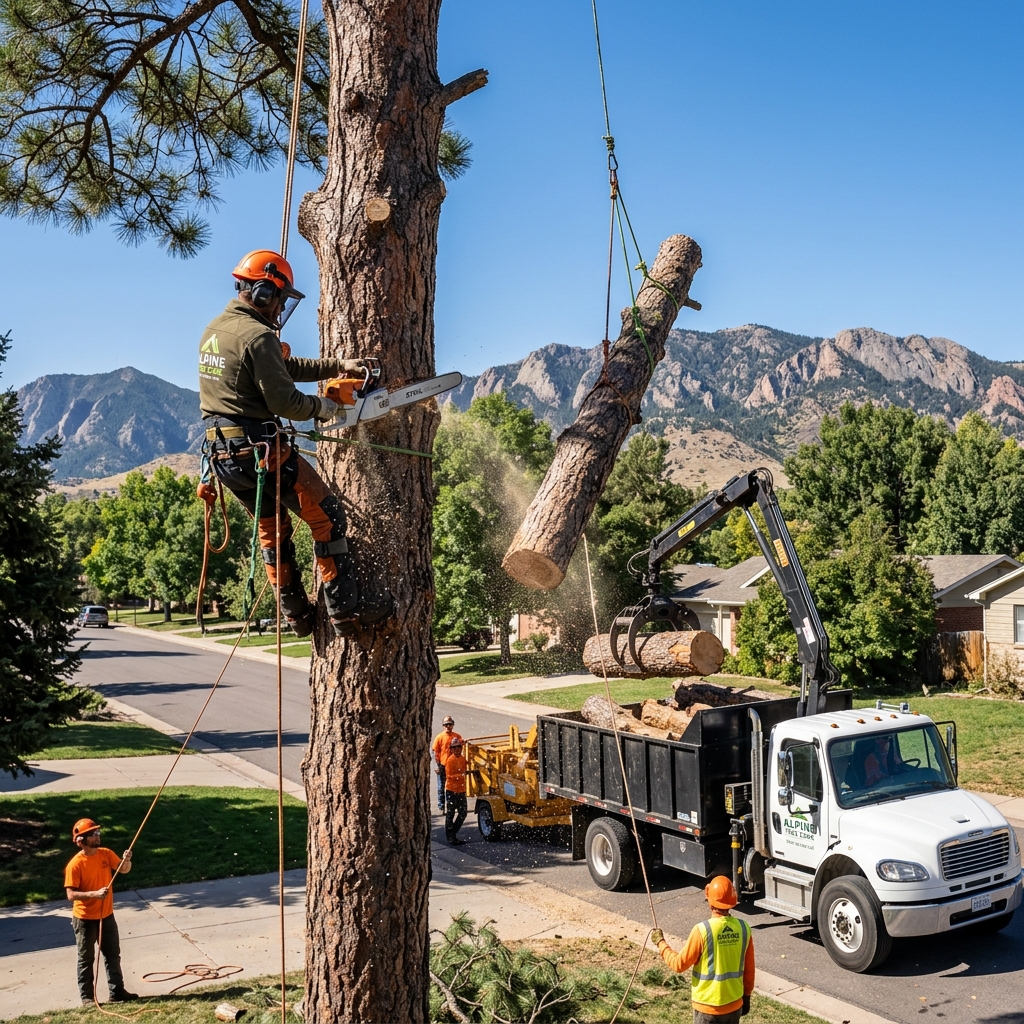
Recognizing Tree Hazards Before They Fail
Trees are dynamic living organisms that provide shade, beauty, and property value. However, when a tree experiences structural failure, it can cause severe damage to structures, utilities, or people. Homeowners often miss the subtle warning signs of internal decay or disease until a major windstorm or heavy snow load triggers a failure. Knowing what to look for can save your tree—and protect your property.
5 Critical Warning Signs to Watch For
1. Deep Cracks & Cavities in the Trunk
Deep splits or cracks extending through the bark into the wood are major indicators of structural instability. Cavities—often formed after poor pruning cuts or pest damage—indicate that the tree is hollow or decaying internally. If a cavity or crack affects more than 1/3 of the trunk's diameter, the tree's structural integrity is compromised, and it should be assessed by an arborist immediately.
2. Dieback in the Canopy
If branches near the top of the tree are bare, leafless, or snapping off easily, your tree is experiencing "dieback". This is a systemic symptom indicating that the tree's vascular system is failing to transport water and nutrients to the upper canopy. Common causes include root rot, soil compaction, drought stress, or severe boring insect damage.
3. Trunk Decaying & Fungal Conks
The presence of shelf-like fungal growths (conks) or mushrooms growing directly from the base of the trunk or major root flares is a serious sign of internal wood decay. These fungi feed on the structural cellulose of the tree, leaving the inside of the trunk soft and sponge-like. A tree that looks healthy in the canopy can be entirely rotted at its base, making it a severe fall hazard.
4. Severe Pest Activity (Beetles & EAB)
Insect infestation can kill a tree rapidly if left untreated. In Fort Collins and the surrounding areas, two major threats exist:
- Emerald Ash Borer (EAB): Attacks ash trees, leaving D-shaped exit holes, serpentine galleries under bark, and canopy thinning.
- Mountain Pine Beetle: Attacks pines, characterized by reddish-brown "pitch tubes" (popcorn-like sap bubbles) along the bark and orange-brown needles.
5. Sudden Leaning & Heaving Soil
If a tree suddenly begins to lean, or if the soil on the opposite side of the lean is lifting (heaving) and breaking, root failure is actively occurring. The tree's root anchor system has snapped or severed, and the tree is in danger of falling. This is an immediate hazard requiring emergency arborist rigging and crane support.
Why Hire a Certified Arborist?
Certified arborists undergo rigorous training and testing to earn their credentials from the International Society of Arboriculture (ISA). They understand the biology of local species, safety regulations, and proper climbing/rigging techniques. Hiring an uncertified or uninsured worker to perform high-risk tree trimming can lead to property damage, tree death, and severe liability issues for the homeowner.
Identifying Severe Front Range Tree Pathogens and Beetle Infestations
Northern Colorado trees face persistent pressure from native and invasive pests and diseases. For conifer species like Ponderosa and Lodgepole Pines, the Mountain Pine Beetle (MPB) and Ips Beetle present a lethal threat. Homeowners should inspect trunks for 'pitch tubes'—popcorn-like clumps of sap pushed out by the tree to defend against boring beetles. If the canopy begins to fade to a rusty red, the infestation has likely taken hold, and the tree must be removed immediately to prevent beetles from spreading to adjacent healthy pines. For deciduous trees, particularly Green Ashes, the Emerald Ash Borer (EAB) has become a critical threat in Larimer and Boulder counties. EAB larvae feed on the inner bark, disrupting water transport and causing canopy dieback from the top down. Other common local issues include Thousand Cankers Disease in Black Walnuts and Cytospora Canker in Spruces. Recognizing these symptoms early allows our arborists to implement micro-injections or soil drench treatments before removal becomes the only option.
Advanced Arborist Solutions: Root Collar Excavation and Cabling
Not all structurally compromised trees need to be cut down. Modern arboriculture offers sophisticated preservation techniques. Root collar excavation involves using specialized compressed-air tools (Air-Spades) to gently remove compacted soil from the base of the tree. This exposes girdling roots—roots that wrap tightly around the trunk, choking off nutrients—which can then be selectively pruned before they cause irreversible damage. For trees with heavy, codominant stems or structural weak points, we install dynamic cabling and bracing systems. High-tensile steel cables or synthetic Cobra lines are anchored high in the canopy to limit limb movement during high-wind events, redistributing the structural load and dramatically reducing the risk of trunk splitting. These systems allow mature trees to remain safely on your property, preserving your landscape's canopy and property value.